
After a Friend Departs.
TW: Death.

We sat in the cafeteria of a homestay in Chhoj, just a kilometre from Kasol. Sun filtered through the windowpane, forming perplexing patterns on the floor, the tables, and the walls. I looked at dust particles dancing and swirling, reflecting gorgeous colours, until they settled on a surface. Everything else around me dissolved and faded into the background. Every now and then, a strong gust of wind parted the heavy curtains and hit our faces. An unfamiliar soundtrack played somewhere far away. Outside, the Parvati River flowed with an unmatched force—both comforting and scary.
A German tourist sat on the other side of the room, carefully crushing and mixing his hashish and tobacco, preparing to roll another joint. Time slowed down to almost a stop in that moment, as if we were in a liminal space. There was nowhere to go, nothing to achieve. A certain sullenness covered the cafeteria like dampness, just enough to make you feel pleasantly melancholic without pushing you away.
It was here, in this moment, that Sudip told me how he found it hard to fit into society, the demands of the capitalist world, the constant fight to find worth in simply existing without the burden of being productive, and the struggle to reconcile with a largely money-focused culture. We talked for hours about imaginary possibilities, about how life had changed since college, and about what was to come.
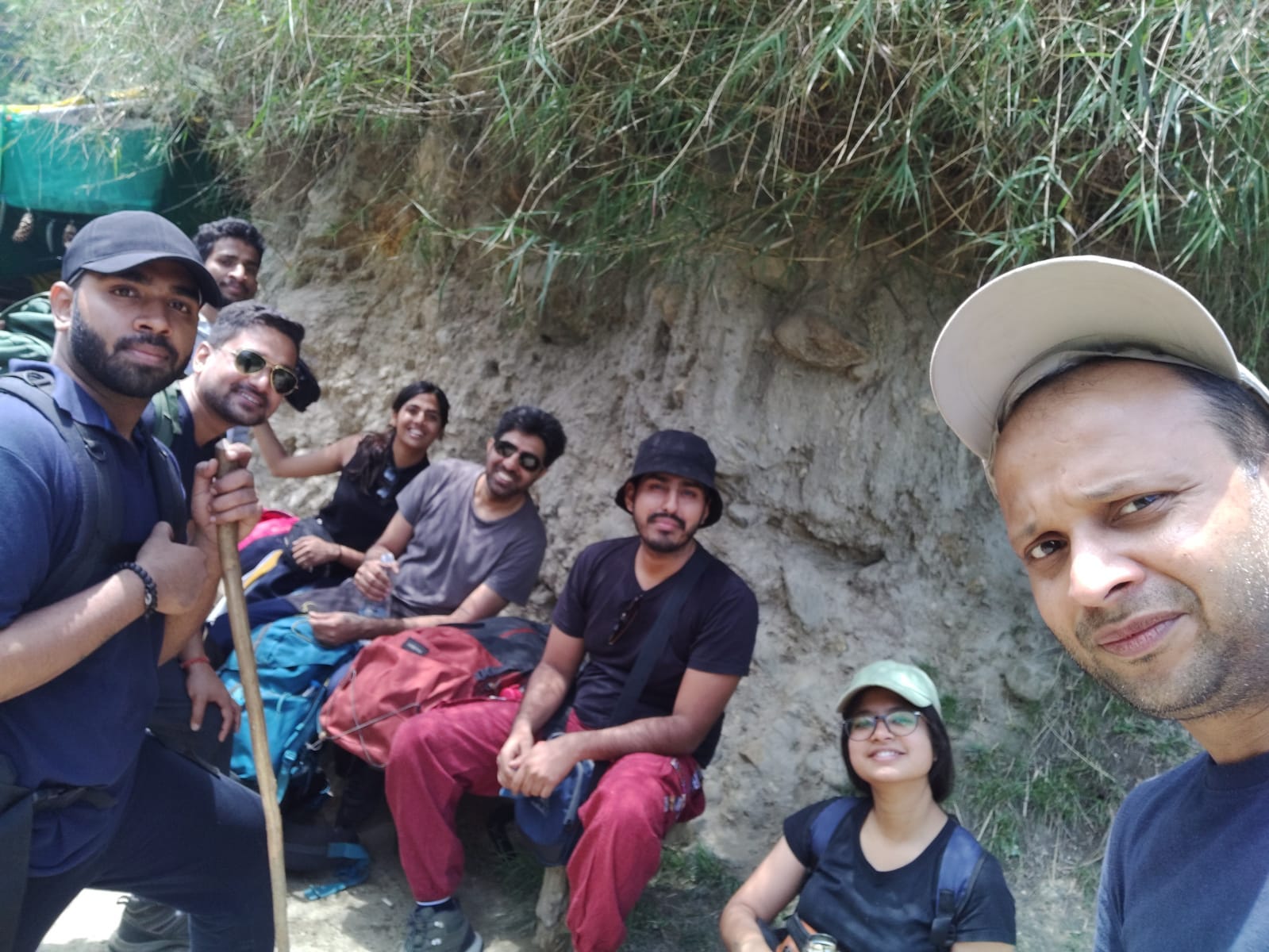
This was the first time we were travelling together after the pandemic, since the small trekking start-up we were building with some other friends was forced to shut shop indefinitely. The trip was an attempt to revive, to reconnect, to reconfigure, and to test if there was any fuel left in us to pursue our passion again.
We spent the next few days hiking the Kheerganga trail, laughing at old, meaningless jokes, relaxing in the hot water springs, and making new friends along the way. This was the last time I saw him truly in his element, assuming the role of a guide for strangers, helping other hikers explore unknown routes, and dreaming again of someday making a living from his passion.
The next time I saw him was at a friend’s wedding. He was more subdued, more resigned to reality. He still spoke of the same dream, but with less conviction. And then life took over. Personal commitments kept him restricted to his hometown. I moved cities for work, and other friends slowly drifted away too. Conversations became rare. Distance grew. Until, in November, he called again, excited to be in Himachal after years.
“We should celebrate New Year’s in Bir. Everyone has to come. No excuses,” he told me during our last conversation.
I never made it to Bir on New Year’s. Neither did Sudip.
Is that what it all comes down to? A quiet shift? A mere flutter, and someone stops existing—just like that?
I always thought of death as a destructive force, moving with the might of the Parvati River, ready to uproot everything in its way. But death, in reality, feels more like a silent whisper calling someone to quietly move on. It’s like a magician’s disappearing act. You keep thinking it’s just a trick. You try to solve the riddle until you give up.
Theory says disbelief is the first stage of grief, followed by denial, and eventually leading to acceptance. But feelings are not universally shared facts. They are deeply personal. And grief hit me first as shock, then confusion. It was disorienting. Reality did not seem real anymore. It wasn’t like the grief you experience from a distance—controlled and regulated. It was like having a concussion after being knocked unconscious, losing all sense of who you are.
I did not feel pain or sadness. I wasn’t numb either. I just felt cheated. Death did not make any sense. How can someone suddenly stop existing? How can someone be there one moment and not the next? You just conveniently start referring to them in the past tense, and everything else stays exactly the same. How?
As if life is a train, moving slowly and consistently, with a deceiving rhythm and an intoxicating motion that keeps you sedated. And suddenly, someone just gets off. You only see their silhouette slowly dissolving into the landscape. And you wonder: what happens to them? Do they walk into the unknown? What IS that unknown? And if there is no unknown, then maybe there’s no train at all. Maybe it’s all an illusion.
“What does it mean to be a self-conscious animal? The idea is ludicrous, if it is not monstrous… It seems like a hoax.”
— Ernest Becker, The Denial of Death
I began writing this piece a couple of weeks after I heard the news. It did not make any rational sense back then. I thought it would, in time. But it still doesn’t. It still feels unreal that a friend is gone and that the world hasn’t stopped even for a moment. That everyone’s first instinct was to tell me it was nothing out of the ordinary, that the only way forward was to meekly accept it.
I thought it would act as an epiphany—a realisation of my own ephemerality and a motivation to live differently. That didn’t happen either. It only happens in the movies.
For the first few days, my hand kept reaching for my chest to feel my heartbeat, to see if something was wrong. I observed my health reports obsessively, looking for signs of trouble. The possibility of an abrupt ending kept staring me in the face.
But within a month, I was fighting the same worries, dilemmas, and fears that define a regular life. Death—the possibility of it—retreated into a corner again. Perhaps this is what they mean when they say “the show must go on”: that you keep the act going, that you keep dancing to the tune, until the music stops, and then—nothing.
“The human condition is just too much for an animal to take; it is overwhelming.”
— Ernest Becker, The Denial of Death
The absurdity of it all is too big to fit into a few words. Maybe that’s why philosophers have pondered death for ages, and yet it continues to baffle us. That’s why we need religions, stories, and myths as crutches.
A month after the news, when I met a common friend, neither of us mentioned Sudip’s name for a long time. And when we did, it was in passing, with apparent discomfort, as if talking about it would make it real.
Every time I forward a meme to friends on Instagram, Sudip’s profile shows up. At first, I thought of sending them to him too, if only for the ritual’s sake. But then I decided against it.
I still haven’t unfollowed him. It would be convenient, but also cruel—for some reason, like betraying a friend. I know life is temporary, and death is the only certainty, but it still feels unfair that someone who wanted to live so passionately was not allowed to. That it could have been me in his place, and the world would have continued in the same way.
None of it makes sense. None of it makes sense.
There is no epiphany. There is no transformation. But now I know: grief doesn’t have to move linearly through all the stages. It can linger at disbelief, at confusion. It can sit there, marinating, until it gets tired and a semblance of acceptance begins to creep in. It doesn’t have to soften the rough edges of absurdity—it only needs to make space for them.
Because every time I think of Sudip, I will pause before saying the words, “he was.”
It will never feel normal.
Postscript
I couldn’t bring myself to finish this piece because of guilt. Was I using a friend’s demise as fodder for creative inspiration? It sat in my drafts, incomplete and unattended. I couldn’t work on anything else for nearly two months.
Until I decided to return to it.
I am putting this out because I need to.
Someone I admire once told me how their friends and family gathered after his mother’s passing to share stories of her and to celebrate her. They found closure in that. Perhaps this is what it’s all about—seeking closure. We need rituals to accept endings.
More than 2.5 lakh years ago, Homo naledi were burying their dead in difficult-to-access caves. They, too, needed rituals to find closure.
This piece is my way of finding that closure and honouring Sudip’s memory.
He got off the train early. But I hope to find him, and all the others, in the great unknown someday. For in the end, we all get off and become a memory.
My condolences Namit! Writing about him is a lovely way to pay tribute to his life.
In some ways, we are primed to expect death of the aged or of pets are inevitable. That doesn't make grief easier to bear. But the feeling of shock you describe hit harder when the death is unexpected. When you think your co-traveler is getting down at the end destination but you wake up one morning and realize they've gotten off the train way earlier than they should. And you've no idea where and have to stay on the train. Bewildering and so hard. I find the Ernest Becker quotes interesting; will look up this book. I'm glad you wrote about this. Tribute and memories aside, sometimes writing helps us process feelings.